


The financial landscape in the United States is shifting again. On September 16, 2026, the Federal Reserve raised the target range for the federal funds rate by 25 basis points to 3.75%–4.00%. The Federal Open Market Committee said economic activity continues to expand at a solid pace, while inflation remains elevated and uncertainty remains high, partly because of geopolitical developments.
For consumers and investors, changes in monetary policy matter because interest rates influence the broader financial environment in which decisions about borrowing, saving and investing are made. A Federal Reserve rate increase does not automatically make every loan or mortgage more expensive by the same amount, nor does it make foreign real estate inherently more attractive.
It does, however, give investors another reason to review how and where they are building long-term wealth.
For Hondurans living in the United States, as well as international buyers with ties to the country, this raises an interesting question: could Honduras deserve a place in that conversation?
Why Invest in Real Estate in Honduras?
Real estate offers something relatively easy to understand: a tangible asset with several potential uses.
A home can provide housing while becoming part of a family’s long-term assets. An apartment or condominium may offer the possibility of rental income. Land can be held for future plans or developed later, depending on local regulations and the characteristics of the property.
For Hondurans living abroad, the decision may also have a personal dimension. Some buyers want a property for their families. Others are preparing for a possible return to Honduras, while some are interested in building a real estate portfolio in the country while continuing to live in the United States.
That does not mean every property is automatically a good investment. Location, purchase price, financing costs, rental demand, maintenance expenses and the buyer’s time horizon all matter.
Tegucigalpa: A Growing Vertical Market With Different Opportunities
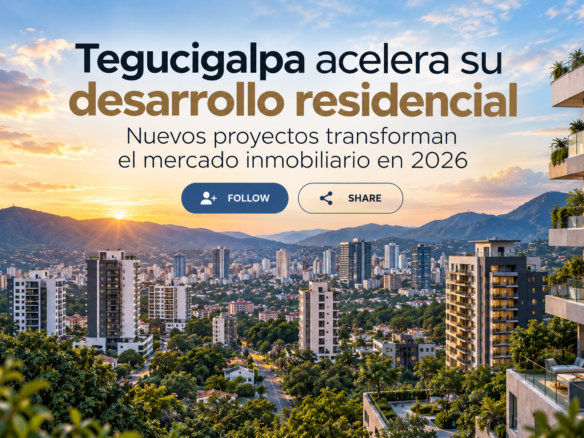
Tegucigalpa is a good example of how Honduras’ real estate market is becoming more diverse. In addition to single-family homes and land, the capital now offers a growing selection of apartments and condominiums in vertical residential developments, particularly in areas such as Lomas del Mayab and Lomas del Guijarro.
For buyers living in the United States, this creates an opportunity to compare different types of properties rather than approaching Tegucigalpa as a single residential market. One West Realty currently features developments such as Torre Astria, Altia Residences, DÖSS and Torre Sky, each representing a different segment of the capital’s condominium market.
Torre Astria
Located in Lomas del Mayab, Torre Astria offers residences ranging from approximately 83 to 151 square meters, with one-, two- and three-bedroom configurations. Selected units have been marketed starting at approximately US$207,500.
Published project information also uses approximately US$2,500 per square meter as a reference for an 83 m² unit and includes an estimated annual appreciation figure of approximately 6.5% for comparative purposes.
That appreciation figure is an estimate rather than a guaranteed return. Actual appreciation will depend on the specific property and future market conditions.
DÖSS
DÖSS, located in Lomas del Guijarro, represents another segment of Tegucigalpa’s vertical residential market. One West Realty’s published references show approximately 100 m² units within an indicative range of roughly US$245,000 to US$310,000.
The final price of a particular residence can vary according to its size, floor, finishes, parking spaces, availability and other characteristics. This is precisely why comparing individual units is more useful than assuming that every apartment within a development has the same value.
Torre Sky
Torre Sky provides an example from a higher price segment. One published reference for a residence of approximately 228 m² lists an asking price of US$525,000.
Comparative information presented by One West Realty uses an estimated annual appreciation figure of approximately 6.5% for Torre Sky. The same comparison includes reference estimates of approximately 7.2% for Torre Vitri, 7.8% for NIVO and 8.4% for DÖSS.
These percentages are commercial estimates provided for comparative purposes and should not be interpreted as guaranteed appreciation or investment returns. Future property values can be affected by supply, demand, location, economic conditions, building management, maintenance and the characteristics of each individual unit.
Altia Residences
Altia Residences adds another option to the condominium market available through One West Realty in Tegucigalpa. Together, Altia, Astria, DÖSS and Sky illustrate an important point for international buyers: investing in Tegucigalpa does not mean choosing from a single type or price level of property.
Buyers can compare location, unit size, asking price, amenities, financing possibilities and long-term objectives before determining which property may fit their plans.
The Numbers Matter, but So Does the Buyer’s Objective
These examples also demonstrate why the total asking price should never be the only number considered. A US$200,000 residence and a US$500,000 residence may serve completely different buyers and investment strategies.
For someone purchasing from the United States, factors such as price per square meter, potential rental demand, condominium or maintenance fees, property management needs, financing and the intended holding period can be just as important as the purchase price itself.
Published asking prices can also change based on availability and individual unit characteristics. Likewise, appreciation percentages should be treated as estimates rather than promises of future performance.
This is where the broader U.S. interest-rate story connects naturally with Tegucigalpa. A changing financial environment in the United States does not automatically make Honduran real estate a better investment. It can, however, encourage buyers with an existing interest in Honduras to compare where and how they want to build long-term assets.
The goal is not simply to buy property in Honduras. It is to identify a property that makes sense for the buyer’s objectives.
Rental Income and Appreciation Should Be Evaluated Separately
One of the most important distinctions for an investor is the difference between rental return and property appreciation.
Rental return is related to the income a property can generate compared with its purchase price and operating expenses. Appreciation refers to how the market value of the property changes over time.
They are not the same thing, and neither should be assumed.
Our preliminary research into Tegucigalpa’s vertical residential market found examples where asking prices and advertised rents imply gross rental yields in roughly the 6%–7% range. However, those observations vary by property, and gross yield does not account for expenses such as maintenance, vacancies, management, repairs or taxes. Some comparisons also involve similar rather than identical units, which means they should not be presented as guaranteed property-specific returns.
For that reason, buyers should evaluate each opportunity individually rather than relying on a single citywide percentage.
What Does the Federal Reserve’s Decision Have to Do With Honduras?
The connection should not be overstated.
The Federal Reserve sets monetary policy for the United States, not Honduras, and its September decision does not directly determine whether a particular condominium in Tegucigalpa will appreciate or produce rental income.
What it does affect is the broader financial environment faced by people living and investing in the United States.
The September decision also came with considerable uncertainty about the future path of monetary policy. Federal Reserve projections are not promises of future rates; they represent individual FOMC participants’ assessments under their respective economic assumptions.
For someone who has been considering purchasing property in Honduras, that changing environment can therefore serve as a reason to review available opportunities, compare the numbers and determine whether Honduran real estate fits into his or her broader financial plans.
What Should an Investor Consider Before Buying?
For an international buyer, identifying an attractive property is only the beginning. Before investing in Tegucigalpa, buyers may also consider factors such as potential rental income, return on investment, expected operating expenses, occupancy and rental demand, property management, financing costs, resale potential and long-term appreciation.
These factors can vary significantly from one property to another. A condominium with a higher purchase price may offer a different rental profile, location or resale market than a smaller residence at a lower entry price. Likewise, an appreciation estimate does not necessarily represent the actual return an investor will receive.
This is why developments such as Torre Astria, DÖSS, Torre Sky and Altia Residences should not be evaluated only by their asking prices or amenities. For an investment-oriented buyer, the broader question is how the property fits into an overall strategy: What could it potentially generate? What will it cost to own and manage? Is there demand for that type of unit? How easy could it be to resell? And what is the investor’s intended holding period?
For buyers living abroad, Property Management can also become an important consideration. An investment property requires local oversight, particularly when the owner lives in the United States or another country.
This is where One West Realty can provide support beyond simply showing available properties. Our team can help buyers explore opportunities, compare properties, understand available financing options, negotiate a purchase and consider Property Management when appropriate.
Buying From the United States Requires the Right Support
Living outside Honduras does not necessarily prevent someone from exploring the country’s real estate market, but distance makes professional support particularly important.
A buyer needs more than photographs of a property. Understanding location, pricing, documentation, financing possibilities, negotiations and the intended use of the property can all influence the decision.
This is where One West Realty can support buyers who want to explore real estate opportunities in Honduras.
Our services include property acquisition and sales, negotiation support, investment guidance, financing options, construction financing, development and construction services, property marketing, and Property Management.
For buyers living in the United States, Canada or elsewhere, our team can also provide local support in Honduras throughout different stages of the real estate process.
Build a Strategy, Not Just a Property Portfolio
A change in U.S. interest rates is not, by itself, a reason to purchase property in Honduras.
But it is a reminder that financial conditions change.
For people who have already considered owning property in Honduras, the current environment may be an opportunity to examine what is available and ask better questions: What does the property cost? What could it realistically rent for? What are the ongoing expenses? How strong is the location? What financing options are available? And how does the purchase fit into the buyer’s long-term plans?
Honduras offers different possibilities, from homes and land to apartments and condominiums in growing urban markets such as Tegucigalpa.
The right opportunity will be different for every buyer.
One West Realty can help you explore those options and determine which properties align with your goals.
Explore Real Estate Opportunities in Honduras
If you live in the United States, Canada or elsewhere and are considering investing in real estate in Honduras, One West Realty can help you explore available properties, financing alternatives and investment considerations based on your objectives.
Honduras: +(504) 3376-5800
U.S. / International: +1 (347) 690-7800


Únete a la discusión